November 10, 2026
How to Choose the Right Brush for Cross-Hole Deburring
December 16, 2025
What Benefits Do Custom Pot Brushes Offer Industrial Applications?
November 11, 2025
Safety Precautions When Working with Wire End Brushes
November 10, 2025
How Deburring Industrial Brushes Improve?

November 8, 2025
How to Clean Narrow-Neck Bottles Effectively Using a Bottle Brush


September 25, 2025
How Wire Wheel Brushes Outperform High-Tech Finishing in Certain Jobs?
September 23, 2025
Why Tube Brushes Outperform Cotton Swabs in Tight Spaces?
August 22, 2025
Top 7 Tube Cleaning Brush Techniques Professionals Swear By
How to Choose the Right Brush for Cross-Hole Deburring
Where two drilled holes meet, they leave a burr. In a hydraulic manifold, a fuel block or a valve body, that small sliver of metal can break loose later, score a seal or block a passage. Cross-hole burrs are hard to reach with a file or a hand tool, which is why most shops use a twisted wire brush made for the job.
This guide covers how to choose that brush: the size, the wire, the style and how to run it.
Why cross-hole burrs are different
A burr on an outside edge is easy to see and easy to remove. A burr where a cross hole breaks into a main bore sits inside the part, often out of sight. It is usually thin and ragged, and it is attached to a curved edge.
A rigid tool tends to either miss it or cut into the bore. A brush works better because its filaments flex. They follow the shape of the intersection, knock off the loose material and leave a small, even edge break without changing the bore size.
Step 1: Match the brush to the hole size
The most common mistake is choosing a brush that is too small. The filaments need to touch the wall of the bore to do any work.
- Pick a brush slightly larger than the bore. As a starting point, choose a brush diameter about 10–20% bigger than the hole. The bristles then press gently against the wall.
- Too large is also a problem. A brush that is far oversize is hard to push in, bends the filaments flat and wears out quickly.
- For very small holes, use miniature brushes. Our Standard and Metric Micro Miniature Deburring Brushes are made for small precision bores in medical, aerospace and electronics parts.
Step 2: Choose the right filament
The filament decides how aggressive the brush is and what it leaves behind on the part.
| Filament | Best for | Watch out for |
|---|---|---|
| Carbon steel wire | Steel and cast iron; fastest cutting | Can leave particles that rust on stainless parts |
| Stainless steel wire | Stainless steel and parts that must not be contaminated | Slightly less aggressive than carbon steel |
| Brass wire | Softer metals such as aluminium and brass | Too soft for heavy burrs on steel |
| Abrasive nylon (silicon carbide or aluminium oxide) | Light burrs and finishing, where size must not change | Slower on heavy burrs |
A simple rule: match stainless wire to stainless parts, and use abrasive nylon when the finish matters more than speed.
Step 3: Pick the brush style
Different burrs need different shapes of brush.
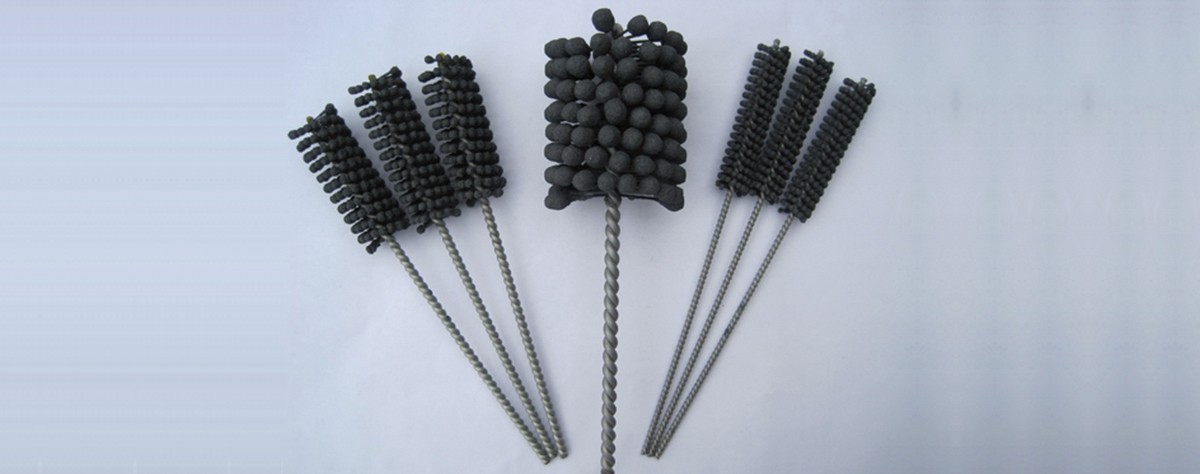
- Twisted wire burr brushes are the standard choice for cross holes. They pass through the main bore and clean the intersection as they go. See our Twisted Wire Burr Brushes.
- Side action brushes clean the wall of a bore or slot with a sideways motion, useful where an end brush cannot reach. See Twisted Wire Side Action Brushes.
- Pencil end brushes work at the tip, for closed-end holes and blind bores where the burr sits at the bottom. See Pencil End Brushes.
Step 4: Hand, drill or CNC?
The same brush style can be used in different ways depending on how many parts you run.
- By hand: fine for one-off repairs and maintenance. Push and pull the brush through the bore while rotating it slightly.
- In a drill or die grinder: faster and more consistent for small batches. Keep the speed low to start.
- On a CNC machine: best for production. The brush runs as a tool in the program, so every part gets the same edge without a manual step.
If you run the brush under power, check the maximum RPM for that brush and never go above it.
Step 5: Run it the right way
A good brush can still give poor results if it is used badly.
- Start slow. Low speed first, then increase until the burr comes off cleanly.
- Use light pressure. The tips of the filaments do the cutting. Pushing hard bends the wire over, reduces cutting and shortens brush life.
- Keep it moving. Pass the brush in and out instead of holding it in one spot.
- Use coolant or cutting oil in production. It improves the finish and helps the brush last longer.
- Wear eye protection. Wire filaments can break off at speed.
Signs you need a different brush
- Burrs remain after several passes: the brush is too small or the filament too soft.
- The bore is scratched or oversize: the filament is too aggressive, so try stainless or abrasive nylon.
- The brush wears out after a few parts: speed or pressure is too high, or the brush is too large for the hole.
Frequently asked questions
Can I deburr cross holes without a brush?
Yes, with tools such as cross-hole deburring cutters or by hand with scrapers, but these can miss burrs or cut the bore. A brush follows the intersection and is quicker for most parts.
What speed should I run a deburring brush at?
Start low and increase until burrs come off cleanly. Never exceed the maximum RPM listed for the brush.
Can one brush handle several hole sizes?
Only within a small range. A brush that is much larger or smaller than the bore won’t work well, so most shops keep a few sizes.
Need a size you can’t find?
Cross holes come in every size and angle, and some parts need a brush that isn’t in any catalogue. Hight Brush makes custom deburring brushes to your drawing or sample part.
Browse our Wire, Burr and Tube Cleaning Brushes, or contact us on 210-860-7896 with your hole size and material, and we’ll recommend the right brush.
View Our E-Catalogue